The Farm Dream
In early 2026, Andrew and I completed a permaculture design certification (PDC) through the Permaculture Education Center. The final project was a site design and encouraged us to consider our goals as well as how to utilize the property according to permaculture principles. Below is our submission which doubles as a road map for our decisions, tasks, and growth in the coming years.
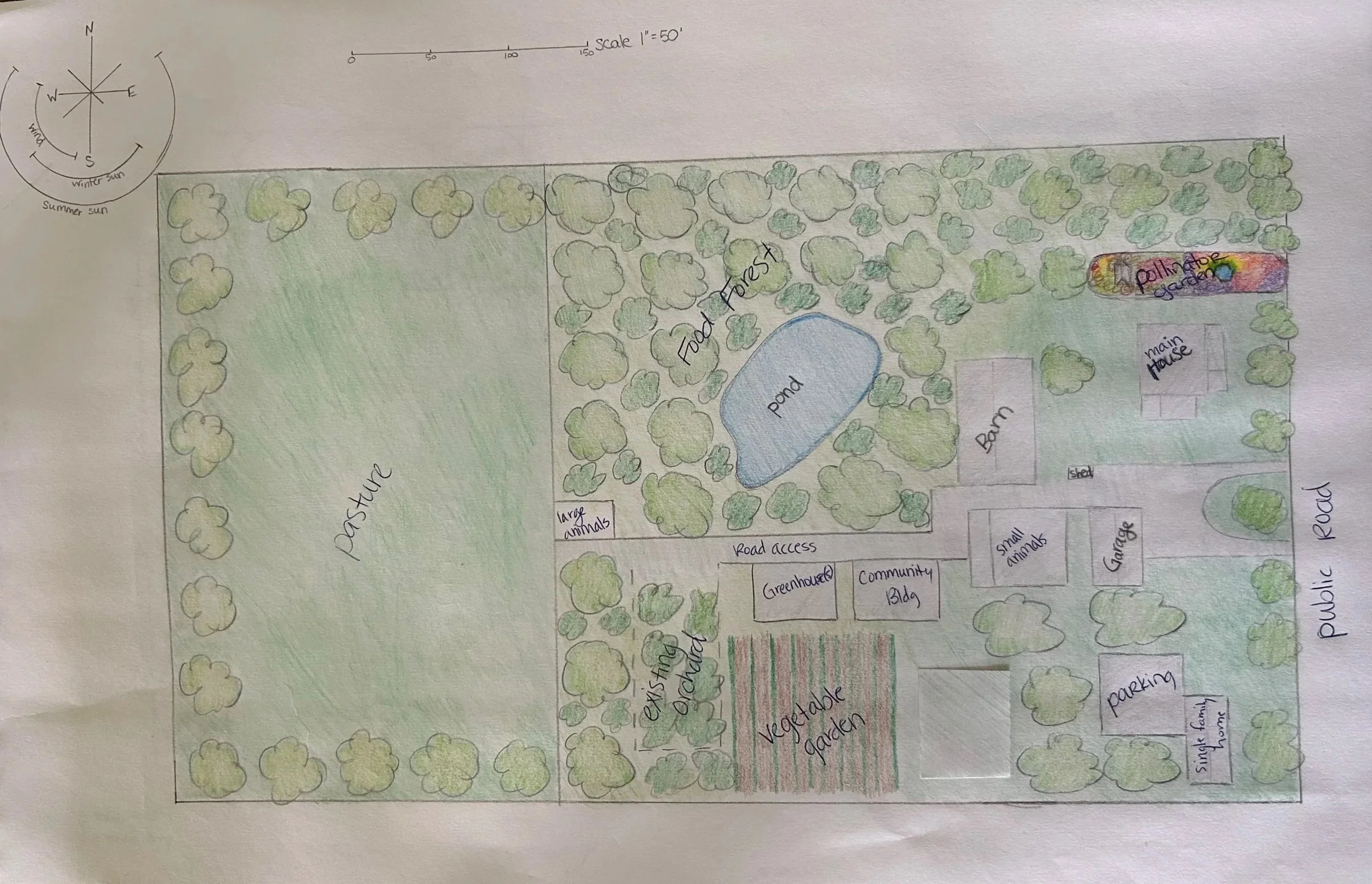
Site Description
We bought my grandparents property in summer of 2025 with the intention of creating a self-reliant homestead for our extended family, while also creating a business from the surplus products.
Location: Pleasant Hill, Ohio, USA
Size: 7 acres, 790ft (east-west) by 385 ft (north-south)
Elevation: flat, no slope. Elevation map shows less than 5 ft. difference across the entire property
Energies: Wind is predominately from the west, to a lesser extent from the south. Surrounding areas are mostly open, commercially farmed fields with little to no existing wind breaks. Neighboring houses are all situated to the north. Site is exposed to full sun. Wind and solar energy are possible.
Disasters: No frequent natural disasters. Most likely would be tornadoes or high-wind. Best defense is wind-break trees planted to the west.
Existing Buildings:
House: 32’ x 26’ (950 sq ft)
Barn 36’ x 64’ (2304 sq ft)
Garage: 42’x24’ (1008 sq ft)
Shed: 18’x9’ (162 sq ft)
Proposed Buildings:
Small animal pen: 40’ x 50’ (2000 sq ft)
Large animal shelter: 20’ x 30’ (600 sq ft)
Second residence: 52’x15’ (780 sq ft)
Community Building (includes a full kitchen, meeting space/classroom, and offices): 30’x50’ (1500 sq ft)
Greenhouse
Goals:
Be as self-reliant as possible (food, water, electricity, fuel, recreation, and other basics).
Share and sell surplus to the community to extend the sustainable produce and products to others as well as providing an income.
Create a permaculture demonstration site for the community by incorporating sustainable design, elements, and practices and sharing them through a farm market, agrotourism, and events.
Site Elements
1: House
We are making efforts to restore the 1940’s farmhouse. The installation of a metal roof and spray foam (basement) insulation was done prior to our purchase of the property. Additional work will be needed to increase the energy efficiency of the home, such as new windows and attic insulation/ventilation. We will be making every effort to choose sustainable and efficient products for these tasks. We are also auditing our energy usage (electricity, wood, oil, etc.) to use as a baseline for energy improvements and to identify target areas for improvement.
The current septic system is old and will need to be replaced in the near future. At that time, we would like to have a graywater system installed. Likewise, we currently have two furnaces - a wood burning furnace, which is oversized for our home and inefficient making it consume more wood than necessary, and an oil furnace that is old and in need of serious repair or replacement. The duct and chimney systems are also old, poorly designed, and in need of reconstruction. When the time comes, we will choose a sustainable and efficient design for the replacement.
We would also like to explore adding solar panels and/or a wind turbine to the property to help offset energy usage.
2: Barn
The existing barn is not a traditional barn. It has low ceilings and poor ventilation, making it inadequate for animal housing or storing large equipment. It also would not be easily transitioned to finished/conditioned space and therefore will be utilized for purposes including a workshop (soap/candles, woodworking), winery, and wormery. This will require very little modification as the building already contains a cold storage space that can serve as a wine cellar and fermentation room. The primary purpose of these spaces will be to use produce from the farm to create new products for added value and income generation.
The wormery will be located inside the barn to provide protection from the elements, and located for easy access, as well as near the compost pile for filling. The worm farm will consume excess organic matter from the household and will provide the site with worms and worm castings/tea for building soil. Surplus worms can be sold for additional income.
3: Garage
The existing garage structure will be used primarily for maintenance and large vehicle/equipment storage.
4: Rain water collection
One of our first projects will be to add gutters to the outbuildings and a rain water collection system. In our region, with our existing buildings, we have the potential to collect an estimated 113,140 gallons of water annually! (https://www.watercache.com/resources/rainwater-collection-calculator?srsltid=AfmBOorCuW_36zFqJ_YPdlKKy09fNNLpAinzKAKOnOqAWDjSXzjwmE4r). This water can be used for plants around the property as well as animal drinking water and for the duck pond. Initially we will be implementing recycled plastic barrels for the purpose of collecting and storing, as well as a cart and hoses to move water around the property, but eventually would like to install a larger storage tank that could integrate with a graywater system and overflow to a pond.
5: Small animals
Chickens, ducks, and rabbits will be incorporated to provide eggs and meat to the farm. Surplus animals and eggs can be sold to the community for additional income.
Unfortunately, we have many predators for these animals (family dogs, hawks, coyotes, and we even caught a bob cat lurking once!), so they cannot be safely free-ranged.
The housing and runs will be made primarily of repurposed wood and hardware cloth. We will also have a net over the top to prevent hawk predators and anti-dig measures to prevent rabbit escapes and/or predators coming in. Temporary/moveable barriers can separate the different animals and allow us to rotate their forage access.
They will have shade from several trees, herbs and other forage plants throughout their run. The area is large enough to accommodate up to 200 small animals, but will likely be home to closer to 50, allowing them more than ample space. They will also receive household scraps, garden scraps, and excess worms from the worm bin for supplemental food. Egg shells are saved and crushed to feed back to the chickens. The duck pond, located within the small animal run, will be filled primarily using collected rain water and will be drained to the surrounding area to water/fertilize the edge of the food forest. Manure can be scraped up and transported to the compost bin/garden periodically. Situating the area between the garage and barn buildings as well as east of the food forest should provide ample protection from wind, sun, and other elements.
We will also make use of chicken tractors to provide pest control in the gardens as needed.
6: Compost
Located at the northwest corner of the existing barn, the compost pile provides a way to reduce household and farm waste, animal manures, and garden litter. Used in conjunction with the wormery to create rich hummus for use in the gardens.
Any prunings, excess animal manure and food scraps from the outdoor area can be placed here. The compost bin will consume household waste including food, plant clippings and paper and cardboard products. Its primary output is organic compost to help build the garden’s soils.
7: Vegetable Garden
One quarter acre will be allotted for the vegetable garden, primarily for annual plants that are not easily incorporated in the food forest. No till practices with 30”wide, permanent raised beds, interplanting with beneficial plants (herbs, marigolds, etc.), cover cropping during off-seasons, mulch, small ponds to encourage frog and toad populations and chicken tractors can be utilized for weed and pest management. This will provide fresh and preserved vegetables for the family as well as a surplus that can be shared and sold within the community. Over time, the soil can be improved with these practices.
8: Greenhouse/Nursery
A small greenhouse (built with repurposed materials) will be situated along the north side of the vegetable garden for the purpose of starting seedlings and trees, extending the growing season, and possibly growing non-native species (such as pineapple, citrus, etc.). Water can be provided from rainwater collection barrels/hoses, etc. and rocket mass heaters can be utilized to maintain temperatures in the winter.
9: Pollinator Garden
A large space is allocated for the revival of my grandmother’s rose garden. While perhaps not the ideal location, the garden will be re-established on the original site. This garden’s function will be multifaceted as a memorial garden, a relaxing/recreational space, and serve to attract wildlife and pollinators to the property. There is an existing concrete pond feature that can serve to attract toads and frogs while also being an aesthetic feature. Unfortunately it is too small to house fish as it freezes every winter.
10: Food Forest
The intention is to fill all unused/unallocated spaces with trees, primarily in guilds for a food forest, but also including native trees to attract wildlife. The food forest will also include paths for recreational use, some natural play features for children (such as climbing structures, swings, playhouse, etc.), and signage for educational purposes so the forest can be used as a demonstration site.
This will increase our resilience and diversity in food by incorporating fruit and nut bushes and trees. Guilds that incorporate herbs and flowers, as well as perennial vegetables (i.e. asparagus, horseradish, etc.), will also provide biodiversity. We intend to focus on native species, heavily incorporating paw-paws, service berries, etc. that will lessen maintenance and labor inputs. Other fruit bushes and plants can be interplanted for the primary use of wine making. The irregular shape will create maximum edge-effect as well as utilizing every available space.
The existing orchard includes multiple apple varieties, an english walnut, and a butternut tree as well as several blackberry bushes. These established trees will allow us to jump into the understory plantings right away and we can expand from this area over the years.
11: Animal pastures and housing
We intend to incorporate goats (primarily dairy as well as some meat), pigs (meat and lard {for candle and soap making}, and alpacas (fiber) on the farm. We have allocated 2.5 acres for pasture use. In addition to providing these materials for the farm, we can sell surplus to the community for additional income.
The pastures will be rotated to maximize the efficiency of the space and maintain appropriate grazing for all the animals. Trees will be sparingly planted to provide wind break and some shelter. Temporary fencing can be utilized to aid with clearing garden spaces, sealing the pond, etc. Manures can be added to compost.
A large animal shelter for shared use will be constructed near the pasture, with road access for moving materials and feed, vet access, etc.
Due to the existing buildings on the property, the size of pasture to be allocated, and other design elements that we wished to incorporate (i.e. the pond, privacy around the home area, windbreaks, etc.), we chose to locate the large animal shelter and pastures farther from zone 1 than would otherwise have been ideal. Furthermore, the back portion of our property is currently tilled field, allowing easy transition to pasture.
12: Cane Break/Bamboo
Unfortunately, asian bamboo is highly invasive to our area and would require extreme, expensive, and unsustainable methods of control. However, River Cane is native to the midwest US and great efforts are taking place nationwide to preserve this grass species. Similar to Asian varieties, it can provide fodder for animals, the shoots are edible for humans, the canes can be used for light construction and crafts, the cane break provides a refuge for wildlife, and provides a large amount of organic matter for composting and mulching. This will be located near the pond due to high water needs.
13: Beehives
These will be situated throughout the food forest and can provide our farm with pollinators and honey. The honey will be primarily for use in our wines/meads production, although some can be used by the farm and surplus can be sold for additional income. Beeswax will be used for candle making. The quantity of hives can be adjusted as we progress; while we have uses for the products, our hope is that enough wild pollinators can be attracted to provide for our needs and that any beekeeping could be managed by other family or community members so that our time can be spent on other elements.
14: Pond
At this time, we intend a 1/4 acre pond to serve primarily for water storage and recreation. It could also provide the opportunity for aquaculture and fish in the future. Once dug, pigs would be run in the area for a couple of years to seal the surface before water is added. Water plants will be placed around the edges, including the cane break, sycamores, river birch, and other native trees that benefit from wetter soil. The pond will be situated in the food forest to serve as an aesthetic water feature as well.
15: Housing
A second single-family unit will provide space for extended family. The residents would be encouraged to assist in homestead duties in exchange for food/products. Due to local zoning requirements, the addition of a second home will require us to split the original 7 acre lot into two parcels, though we will continue to use it as one.
16: Community Building
Intended uses include:
A kitchen that can be used for preserving produce and producing cottage foods for sale to the community thus keeping the extra heat and moisture out of the main house as well as a sanitary space away from family pets.
Offices.
Learning Center and meeting space for community workshops and events.
Public bathroom.
Playspace.
This steel frame structure would be centrally located to provide easy access for all resources and people on the property. It will serve to centralize many functions and resources on the farm, as well as provide a space for community engagement and education. A compost toilet and solar shower will be set up as an additional resource and educational opportunity. The playspace will provide a safe, enclosed area with natural play elements for children to use while parents engage in learning or other farm activities.
17: Energy
Due to the rural area, flat landscape, high wind inputs, and lack of existing wind breaks, wind energy is an attractive alternative for us to explore further. A solar panel array is also something we would like to include. We have discussed the possibility of several locations for these, including integrating them into our pasture area. We currently do not have a thorough plan in place, but are very excited about pursuing these options in the future.
Progression
The site plan will take several years to complete so the implementation order may vary but is currently planned as follows:
Initial:
Basic rainwater collection
Introduce small animals
Vegetable garden beds established
Begin food forest
Pollinator garden
Second single-family housing unit
Intermediate:
Large animal pastures and shelter
Dig pond & begin planting water trees/plants
Expand food forest
Begin wormers
Greenhouse added
Final:
Continue expanding food forest & water plants
Beehives introduced
Farmhouse improvements complete including HVAC, grey water systems, and energy solutions
Community building added